/your message
has been successfully
sent
has been successfully
sent
Thank you for choosing our company.
Our specialists will contact you as soon as possible.
Our specialists will contact you as soon as possible.
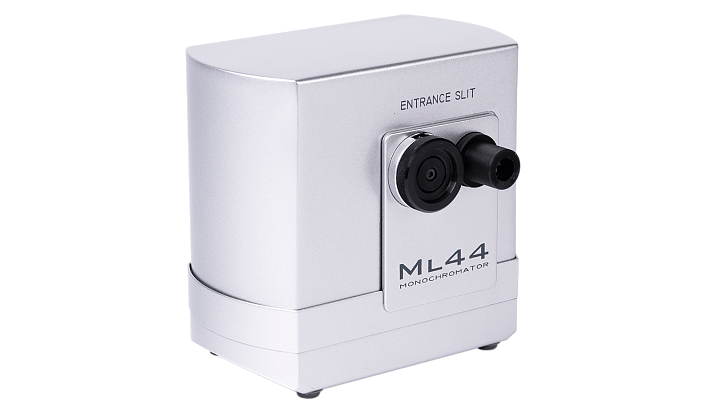
The ML44 monochromator comprises two diffraction gratings mounted on a single rotation axis. Spectrum scanning and diffraction grating change are automated. The wavelength for automatic gratings switching is set by the user in the instrument software.
Entrance and exit slits are changeable; they are mounted on two six-position discs. Each disc contains six spectral slits pre-aligned by the manufacturer. To change the slit width you just need to manually rotate the knob moving it to one of its six fixed positions. Two indicators on the ML44 housing show the widths of entrance and exit slits, and the software calculates the spectral width of the line separated by the monochromator.
The delivery set contains two optical fiber adapters and two fused silica condensers. Condensers and fiber adapters can be installed on the entrance and/or the exit slit. The condenser is used to focus the light onto the monochromator entrance slit, as well as to focus the light, coming from the monochromator, to the object. Fiber adapters allow to transfer the light to/from the monochromator via optical fibers (SMA-905 connectors). Optical fibers can be supplied upon your request.
Scanning control is performed from a computer via the serial RS-232 port. The delivery set contains a USB-RS232 adapter providing the USB interface.
SDK, DLL are supplied with the ML44 for controlling the instrument via the customised software or LabView.
A distinctive feature of the ML44 monochromator is the use of high-quality achromatic lenses as a collimator and a camera instead of mirror optics. This ML44 feature provides a number of its significant advantages over other short-focus monochromators:
.png)
| Parameter | Value | |
|---|---|---|
| Spectral range,nm | 190-1200 | |
| Focal length of the collimator and camera lenses, mm | 44,2 | |
| F/Number | 1 : 2,9 | |
| Diffraction gratings | ||
| Size, mm | 25 * 20 * 6 | |
| Grooves/mm | 1200 | 600 |
| Blaze wavelength, nm | 270 | 600 |
| Reciprocal linear dispersion (average), nm/mm | 18,7 | 34,7 |
| Spectral range, nm | 190-600 | 600-1200 |
| Wavelength of automatic change of grating, nm | 600 (program controlled) | |
| Tuning step by angle, deg | 0,01875 | |
| Tuning step by spectrum, nm | 0,125 | 0,25 |
| Wavelength tuning accuracy, nm | ±1,0 | ±1,5 |
| Wavelength repeatability, nm | ±0,25 | ±0,5 |
| Scanning rate, nm/s | 200 | 400 |
| Entrance/exit slits (changeable) | ||
| Slit width , mm | 0,02; 0,05; 0,1; 0,25; 0,5; 1,0 | |
| Slit height, mm | 3,0 | |
| Spectral interval chosen by ML44 at width of entrance and exit slits (average) | ||
| Slit width 20µm | 0,35nm | 0,7nm |
| Slit width 50µm | 0,9nm | 1,8nm |
| Slit width 100µm | 1,8nm | 3,5nm |
| Slit width 250µm | 4,5nm | 8,9nm |
| Slit width 500µm | 9,0nm | 17,7nm |
| Slit width 1000µm | 18,0nm | 35,5nm |
| Computer interface | USB | |
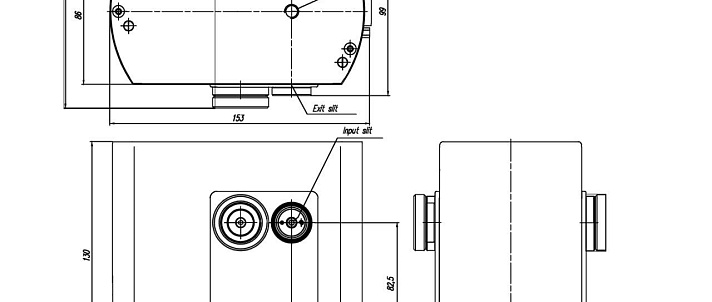
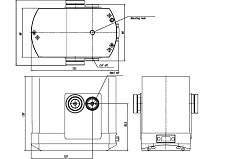
| Dimensions, mm | 138,5 * 114 * 147 | |
| Weight, kg | 2,1 | |
The ML44 monochromator has a wide range of options and accessories that provide efficient light collection from the sample located at a finite distance and at infinity, delivering emission to the monochromator with and without an optical fiber, effective aperture matching of the optical fiber and monochromator.
Cassegrain lenses allow collecting light from objects located at a distance of 3.5m to infinity.
Adapters PS-2 and PS-3 are designed for the collection of light from a closely located sample and its effective input into an optical fiber. PS-2 features high transmittance in the UV range, while PS-3 has the possibility of installing an edge filter.
Contact a SOLAR LS specialist to select the complete set of the device that meets the requirement of your instrument complex in the best way.