/your message
has been successfully
sent
has been successfully
sent
Thank you for choosing our company.
Our specialists will contact you as soon as possible.
Our specialists will contact you as soon as possible.
Task:
Development of a laser system with a narrow generation line for the dual-wavelength digital holographic interferometry method to analyze the surface walls of a "TOKAMAK" experimental thermonuclear reactor. The goal is to determine the nature of their damage caused by high-temperature plasma during thermonuclear fusion processes.
This method enables the evaluation of the amplitude and phase of the wavefront by analyzing the interference between the reference and object beams. Two holograms at different wavelengths are recorded either simultaneously or sequentially using one or two tunable lasers. The spatial distribution of the phase difference extracted from the holograms provides information about the surface profile. The main challenge in applying this method for diagnostics is the necessity of placing optical elements near the TOKAMAK chamber, which can lead to phase shifts due to vibrations and thermal distortions. To make the system insensitive to vibrations, a setup based on a pulsed laser and optical vibration compensation methods must be used.
Client:
State Corporation "Rosatom"
Solution:
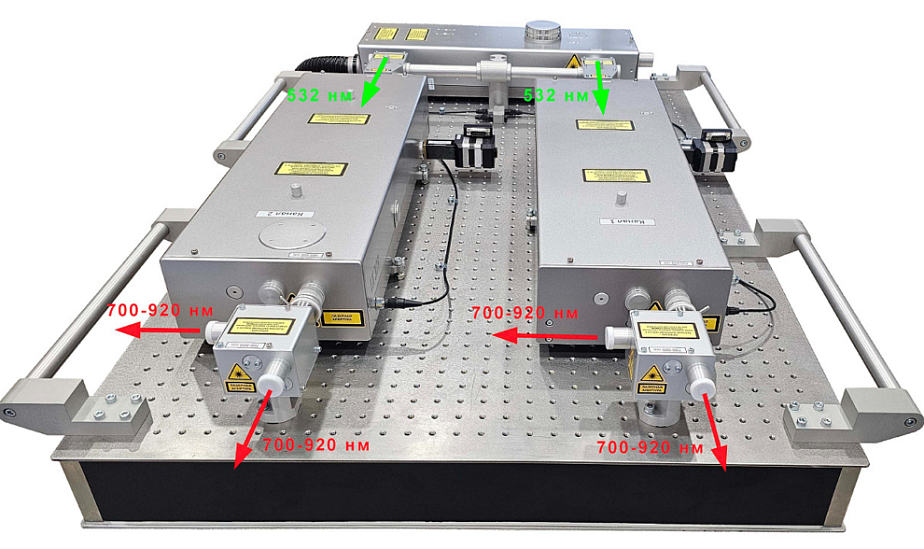
The laser system was developed and designed by our specialists based on titanium-sapphire lasers, with the capability for independent adjustment of pulse energy in each of the two optical channels and equipped with a pump splitting unit. This system enables the construction of a digital holographic contactless image of the walls of a TOKAMAK with high resolution, facilitating future research on industrial-scale thermonuclear installations without the need to access the reactor zone (using the method of optical contactless inspection). This approach will significantly reduce time and financial costs while providing a reliable means of monitoring the quality and condition of the reactor’s working surface. The system has no analogs in the CIS countries or abroad.
Main system parameters:
| Number of channels | 4 |
| Wavelength tuning range | 700 …. 920 нм |
| Maximum output energy in each channel | ≥12 мДж |
| Spectral line width of generation | ≤5 пм |